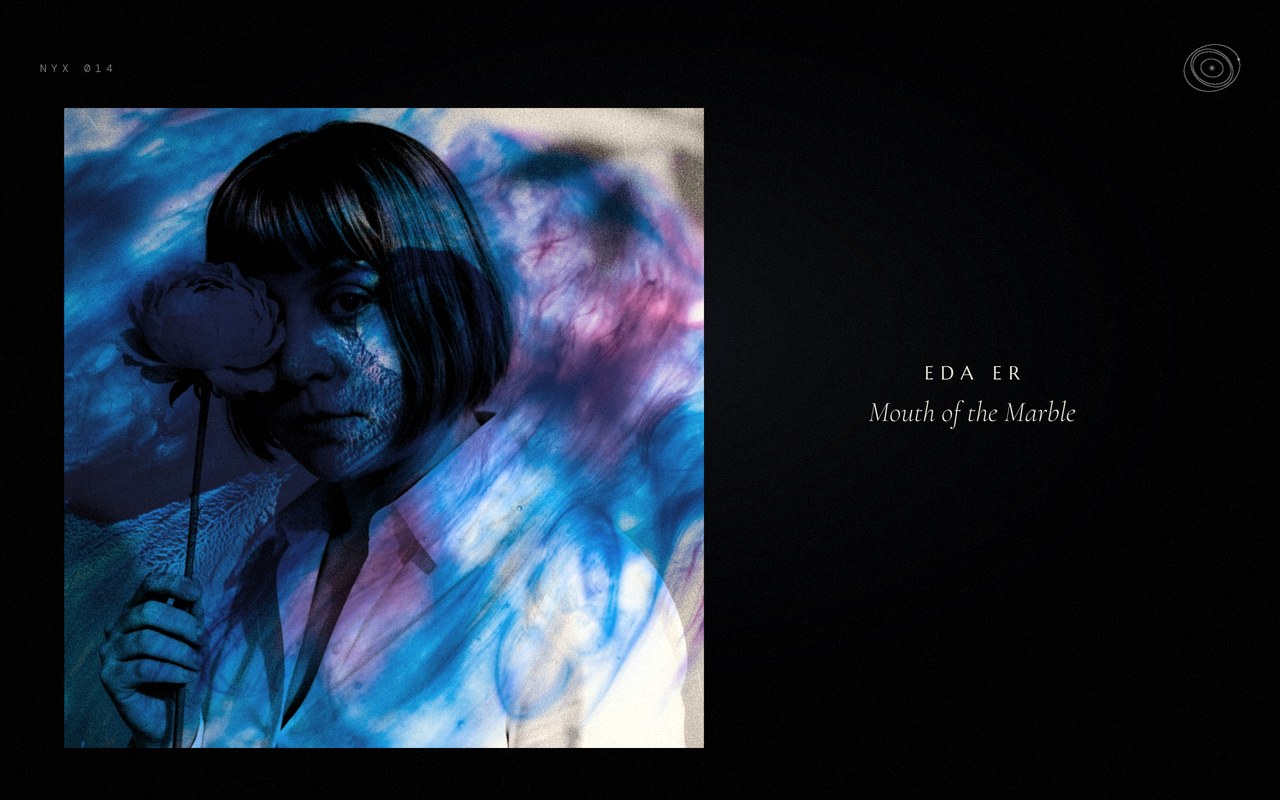
The Tray Is a Mouth: Eda Er’s Mouth of the Marble
Five ritual actions for voice, water and machine. ~25 minutes.

Ebru, the Turkish art of paper marbling, is usually described as painting on water. Pigment is floated on a thickened bath, combed into patterns, and lifted off onto paper in a single pull. Eda Er has spent years turning that tray into an instrument. On Mouth of the Marble she does something stranger: she stops treating it as an instrument at all. The tray is a mouth. Across five pieces it learns a language, refuses a name, catches a fever, is prayed to through a thinning wall, and finally closes over the sky.
The premise sets the terms of the sound. A woman sings into water, and the water answers in machine language. The voice throughout is Er’s own solo recording, never pitch-shifted, only cut, retriggered and granulated at original pitch. Every other sound is drawn from her own sample pool: an industrial loop sliced into beats, a hundred-hertz speaker tone repitched into every bass and sub on the record, low instrument tones frozen into bells and walls, a creature’s croak for the machine’s answers, an off-hook telephone tone for a refusal. Nothing is synthesised from nothing. The result sits between divination and club ruins: wet electronics, a diseased four-on-the-floor, Turkish vowels whispered at close range, swelled bells, a soprano that keeps melting into gloss. Everything low is mono and clean. Everything high is kept dark and wet.
Five actions
“Oil Tongue” is the tray learning to speak, and the language it learns is hers. Breath, saliva-clicks, whispered vowels, the small sounds of the comb on the surface; then her real sung fragments surfacing between the synthetic whispers, each answered a moment later by a warped double of itself, the water repeating her imperfectly. The last phrase goes unanswered. Then the voice is granulated into oil, grain by grain, and the surface closes.
“The Water Refused My Name” is paperwork turning into a rave. A broken kick grid at 132, full of dropped and displaced beats, rubber-stamp percussion colliding in threes against the fours, a name tried and tried again in stuttered whisper fragments. Every hard cut keeps the sub underneath, because the water never actually leaves. At the end the name is sung once, whole, and pulled flat semitone by semitone until the water swallows it.
“Pink Disease / Dancing Plague” is Strasbourg, 1518, the summer a city danced itself to exhaustion. The vocal loop returns every four bars but never identical; with each wave of fever it comes back faster, more jittered, more saturated, until an echo-dancer joins it uninvited. The kick itself sickens and detunes as the fever rises. Dancing because you are cursed, not because you are free. It ends with a heartbeat, one last flattened loop, a breath.
“I Was a Room Before I Was a Woman” is the emotional centre: a slow prayer in D minor sung inside a resonant room, drones as walls, glassy electronics as windows, sub-bass felt through the floor. The whole piece is governed by one parameter, the thickness of the wall between you and the voice. It thins over four minutes until the prayer is almost in the room with you, then closes again, leaving the hum inside.
“Marble Eats the Sky” is ceremonial and cosmic. Stacked soprano drones are the sky, swelled bells strike a slow ritual pulse every thirteen seconds, a D pedal holds the earth. Twice the surface is stirred and the whole harmony slips a semitone down into a darker world; the first time it comes back, the second time it does not. From the midpoint the voice stops narrating and is granulated into texture until there is no singer left, only marble. It ends with one enormous bell, a hanging grain of voice, a single droplet.
The verdict
The whole EP breathes around D, and the fact that it ends a semitone lower and stays there is the record in miniature: a transformation that is not a resolution. What makes Mouth of the Marble more than a concept is the discipline of its materials. Because every sound is either her voice or something she recorded herself, the machine’s answers have the same grain as the questions, and the water really does seem to be talking back in a language it learned from her. Twenty-five minutes, one surface, and by the end you are not sure which side of it you are on.
Mouth of the Marble by Eda Er — five ritual actions for voice, water and machine, ~25 minutes, 48 kHz / 24-bit, stereo and quadraphonic 4.0. Composed, produced, mixed and mastered by Eda Er; all voice her own, at natural pitch. Released 3 July 2026.
Tracklist: 1. Oil Tongue (4:37) · 2. The Water Refused My Name (4:26) · 3. Pink Disease / Dancing Plague (4:48) · 4. I Was a Room Before I Was a Woman (5:49) · 5. Marble Eats the Sky (6:07).
Also available at nyxphere.bandcamp.com.